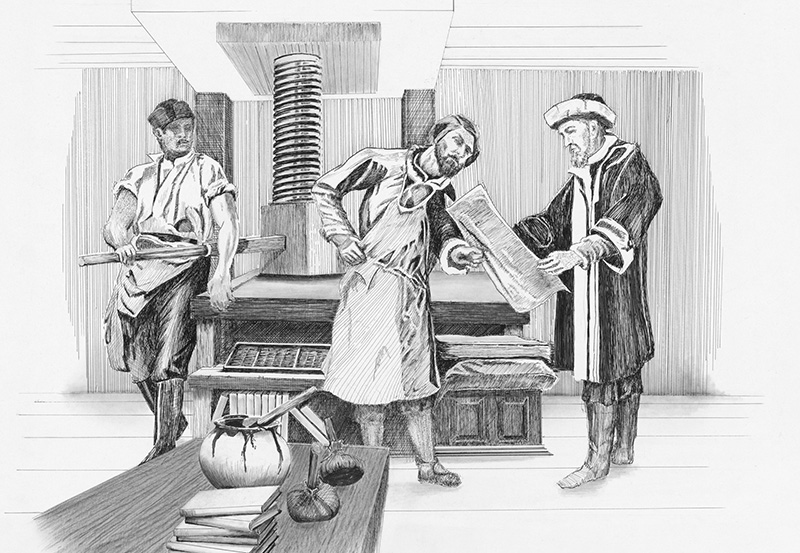
The Printing Press and the Unitas Fratrum Mlada Boleslav, 1501 is a pen-and-ink drawing by Bill Needs ’62 and is part of the latest exhibit at Payne Gallery.
When alum Bill Needs first picked up a pencil to create art, he was nearly 70 years old. Today, his work is on display as part of the latest exhibit in Moravian University’s Payne Gallery.
Up close, the drawing is a fascinating maze of ink lines, crosshatching, and delicate stippling. Step back, though, and the seemingly abstract marks fall into place, revealing a scene from the early history of printing.
Three men gather around a printing press, two leaning in to examine a fresh page. In the foreground, a pot of ink, books, and hand-held stamping tools offer clues to the painstaking work behind each printed page. Together, these details capture a moment in Moravian history.
The Printing Press and the Unitas Fratrum Mlada Boleslav, 1501 is a pen-and-ink drawing by Bill Needs ’62 that brings to life the story of the Moravians’ early printing tradition. The work is part of Bill Needs: A Visual Journey Through the History of the Moravian Church, the latest exhibit at Payne Gallery.
The story behind the artwork is as remarkable as the drawings themselves. Needs, now 87, didn’t begin drawing until he was nearly 70. What started as a retirement hobby grew into a passion—and eventually a way to reconnect with the university (and the Moravian Church) that helped shape his life.
Needs’s illustrations will be on display through December 18. Accompanying the exhibit is an interactive, digital story map designed by students that shows which part of the world the drawing’s subject originated from and a blurb about its history. Needs, a longtime resident of Georgia, will visit Payne Gallery for an opening reception and artist talk from 6 p.m. to 8 p.m. on November 11.
The Non-Traditional Artist
When his exhibit at the Payne Gallery is over, Needs will donate all 31 drawings to Moravian University’s archive so that they can be enjoyed for decades to come. He hopes visitors to the exhibit will come away with a deeper appreciation for the Moravians’ fascinating history and enduring commitment to education. “Maybe they might even pick up a pencil and realize they have something to say that might otherwise remain hidden,” Needs says.
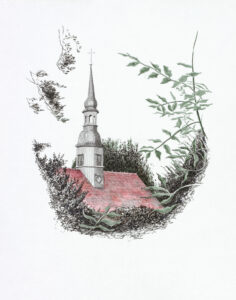
He admits that academics were never his strong point. He grew up in rural Ohio, graduating in the lower-half of his high school class. He planned on becoming a farmer until his father pushed him to attend university. Needs learned about what was then Moravian College in Bethlehem, Pennsylvania, after a group of men from the school’s glee club visited the church Needs’s family attended in Ohio.
“Moravian University took a chance on me, and I was fairly successful in what I did,” Needs says. That’s why he wants to give back.
He majored in history with a minor in sociology, briefly attending Moravian’s seminary before deciding it wasn’t for him. After graduating in 1962 he became a rehabilitation counselor, working with individuals with disabilities to help them get jobs and live independent lives.
A Retirement Hobby
Needs first considered drawing after he retired in 2004 and saw an ad in the newspaper that promised participants could learn to draw in pen and ink after just five classes.
During the first class, the teacher showed students a picture of a barn scene in winter and asked how they would draw it. “Everyone else treated it like a race,” Needs says. He carefully divided his paper into squares and started drawing the scene frame by frame.
“The teacher was watching me and said, ‘Hey that’s pretty good.’”
Needs began taking copy paper with him on trips and drawing pictures when he found the inspiration. Today, Needs never leaves the house without his sketch book, adding that he could even sit at a bar and sketch while relaxing with a beer.
“To have had no interest in art or museums and then to discover this later in life, it’s really been a blessing. It’s almost like a Christmas present,” Needs says.
He and his wife, Sara, don’t have children so they would travel often. Sara was attracted to cities and spending time at art museums, but Bill preferred to avoid the bustle of tourist destinations.
He would tell Sara, “I want to go out in the countryside where it’s pretty. What time do you want me to pick you up?”
When Needs started drawing after retirement, he says Sara couldn’t believe it. Their house in Marietta, Georgia, where the couple have lived for 50 years, is like a museum of Needs’s work, with multiple pictures displayed on every wall.
There’s a portrait of a toddler cautiously walking down the stairs, an ink and pencil rendering of Needs’s grandmother churning apple butter, and even the original winter barn scene he drew as part of his introductory art course more than 20 years ago.
The Exhibit
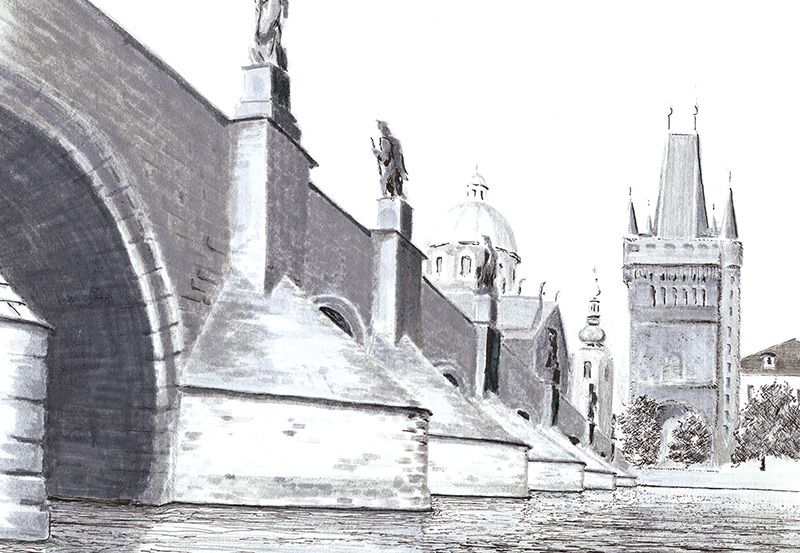
The drawings featured at Payne Gallery are the result of sketches Needs made from photographs he took during a 2017 trip to Prague and the Czech Republic with Moravian University’s Theological Seminary. Moravia, where the Moravians originated from, is located in the eastern half of the Czech Republic and Central Europe.
Captivated by the Moravians’ story, Needs used his sketches and photos to later draw full-size pictures of the sites he visited and depictions of the history he learned about. For example, Lesser Town Prague, gives a glimpse of the Baroque and Renaissance-style architecture in one of the Czech Republic’s oldest and most picturesque historic districts. Begone, Banishment of Bohemian Brethren, 1526, depicts a scene from when many of the brethren and their families fled Bohemia in search of religious freedom.
The exhibit will coincide with the Institute for Moravian History and World Heritage’s inaugural conference, November 12–14, which is expected to draw up to 250 attendees from around the world to Moravian University’s campus.
Given the rich history behind Needs’s artwork, Katherine Faull, the institute’s founding vice president and executive director, and Robert Sparrow Jones, the new director of Payne Gallery, saw an opportunity to deepen the exhibit experience with a digital component.
The accompanying story map will provide historical context and background for each of Needs’s drawings. Visitors can access the site through their cellphone or one of several iPads that will be provided at the gallery.
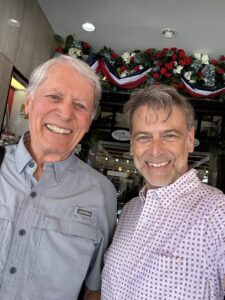
“I was so impressed when I first talked to Bill that he had not studied at art school. He just started drawing, and I love that,” says Sparrow Jones, who was an art professor for many years.
Sparrow Jones would always tell his students that anyone can draw. “I’d have students come to class and say they can’t even draw a stick figure, but everyone can draw. You just have to learn how to do it, and Bill’s work is a great example of that.”
Sparrow Jones started as director of Payne Gallery in July. Soon after, the two men met one afternoon during Bethlehem’s Musikfest when Needs rented an SUV and drove his artwork more than 800 miles from Georgia to the Payne Gallery.
Sparrow Jones most recently served as the curator and senior gallery director at Penn State’s HUB-Robeson Galleries. While there, Sparrow said he and his team were always thinking of ways they could digitally share art exhibits, making them accessible to anyone.
He asked Cory Dieterly, Moravian University’s archivist, if he could help create a digital component to go with the exhibit. Dieterly worked with history major Ellie Umstead ’28 and computer science major Riley Trigo ’27.
They used StoryMapJS, an open-source tool developed by Northwestern University to build interactive map-based digital stories. The students also drew on a blog series published in a Moravian Church Southern Province newsletter. In 2020, Needs contributed historical information about many of his Moravian-inspired drawings for the series.
“What was most enjoyable about this exhibit was learning about Bill and his craft through his blog and artwork. It showed us the depth of an artist’s soul and how meaningful it is to create,” Umstead wrote in an email, adding that neither she nor Trigo were as well-versed in Moravian history when they started the project. “It was an engaging way to learn more about the Moravians’ heritage and values, which is crucial to understanding the importance of our university as a whole.”