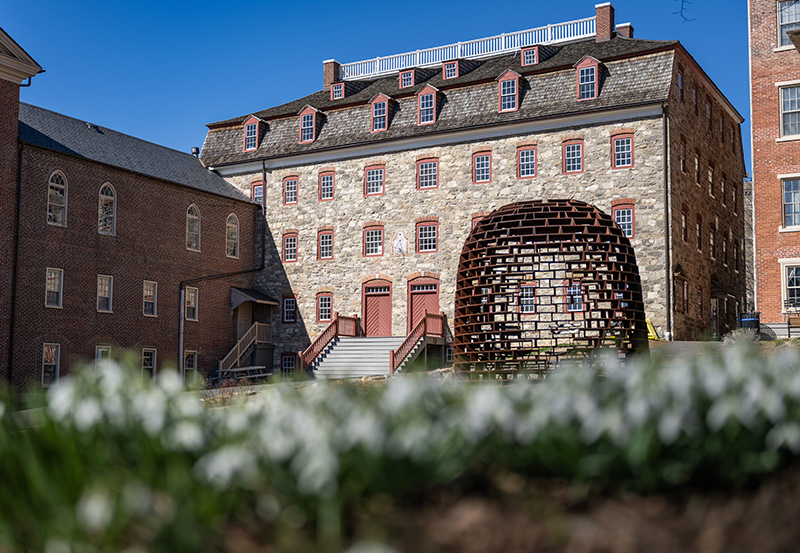
The Single Bretheren's House in Bethlehem is part of the Bethlehem World Heritage site. Photo by Nick Chismar ’20
When the Institute for Moravian History and World Heritage hosts its inaugural conference this fall, it will build on decades of precedent and centuries of world-recognized Moravian history and culture.
The conference is scheduled November 12–14 at Moravian University’s Haupert Union Building (HUB) on the Main Street Campus and planned in collaboration with the Moravian Archives. The public can register online up to Nov. 12. A hybrid format will allow both in-person and virtual attendance. More information is available at moravianconferences.org.
The conference will be the largest assemblage of experts in the field of Moravian World Heritage and digital humanities. More than 50 presenters are expected, along with up to 250 attendees from around the world, including representatives of local governments. It will explore Moravian history in a global context, examining communities, their preservation, and impacts as well as efforts to document, digitize, and share records.
“The reason you should come is not because it’s the biggest, but because it’s the first time that the conference is focused on cutting-edge digital approaches to the interpretation of world heritage,” says Katie Faull, founding vice president and executive director of the Institute for Moravian History and World Heritage.
The conference will serve as an official introduction for the institute, which softly launched last year and seeks to position itself as a global hub for Moravian studies.
The broad scope follows from the 2024 UNESCO World Heritage site designations. Moravian Church Settlements in Bethlehem, Pennsylvania; Gracehill, Northern Ireland; and Herrnhut, Germany joined a settlement in Christiansfeld, Denmark, which had already been recognized as a World Heritage site.
Sites are selected for their “outstanding universal value.” That means communities must demonstrate their significance not just locally, but globally. Other World Heritage sites such as Independence Hall or the Statue of Liberty, for instance, were selected not for their importance to American history, but as symbols of universal human rights. What equivalent do Moravian communities such as Bethlehem offer?
Faull says the answer requires an interdisciplinary approach. As such, the conference seeks to explore topics in the humanities, history, theology, and global cultures.
“In today’s day and age, we’re constantly talking about divisions,” Faull says. “But, what are the values that unite us as human beings?”
The World Heritage designation is a driving factor in this inaugural conference, as evidenced by the program of events. One session of lectures grounded in the present will examine the sustainability of World Heritage Sites, including Bethlehem itself, and the role of the Moravian Archives. Another will look at case studies in heritage preservation from Moravian communities in the U.K. and Germany. Other sessions will consider aspects of digital humanities, such as analysis, access, interpretation, and public engagement.
As for history and global reach, two entire lecture sessions are dedicated to interactions with indigenous communities in the continental U.S., Alaska, and Greenland. Another session will discuss Moravians in Tanzania, and three additional lectures will look at missions in Asia.
Of particular note are the two keynote speakers. For the Moravian Historical Society Keynote Lecture on November 12, Simon Woodward, a World Heritage industry consultant and Cultural Tourism Committee chair for the International Council on Monuments and Sites (ICOMOS) UK, will discuss how to communicate heritage values with varied audiences.
For the Walter Vivian Moses Lecture in Moravian Studies, the closing keynote on November14, Katharine Gerbner of the University of Minnesota, will combine archival scholarship with an exploration of the Afro-Moravian Atlantic. And don’t forget about the music. Several sessions touch on performance topics with titles such as “The Benigna Monologues: Interpreting Moravian History Through Performance,” or “Breaking the Museum: The Past, Present, and Future of Moravian Music.” Even the renowned Bach Choir is scheduled to perform.
This seems appropriate. This inaugural conference is the continuation of a music-focused series that began decades ago, with a one-off scholarly gathering in 1995 on renowned Moravian organ-maker David Tannenberg, who in the later 1700s famously built the church instruments, some which still survive. Seeing potential, the college music department held a follow-up conference the next year about Johann Friedrich Peter, a famous Moravian composer from the same period. The conferences continued roughly every two years and expanded to include both music and history.
”Moravian music is a world heritage that needs to be recognized and celebrated,” says Carol Traupman-Carr ’86 , who is now the university’s vice president of institutional effectiveness but was then a music professor who attended that first gathering and encouraged its continuation. Though not involved in the current iteration, she says the shift to include history was natural—music was both influenced and influential as Moravian society expanded into new areas, combining elements into modern traditions.
“This is not just purely for people who study the Moravians” but for anyone interested in the communities they reached,” says Paul Peucker, archivist at the Moravian Archives. Peucker is on the planning committee for this inaugural conference and has been involved in planning its predecessor events since 2004.
Ultimately, this year’s inaugural conference will fulfill a goal Peucker said he set decades ago: establishing, through the archives and now together with the institute, a worldwide resource center of historical and cultural information on the Moravians. The conference will bring together scholars from all over the world to speak, learn, have conversations, establish continued dialogue, and, hopefully, spur new ideas and collaborations.
And, Peucker says, perhaps some will draw inspiration from the location itself: “Moravian University is right at the site where these historical events took place.”
Bethlehem is one place where the culture and history all came together. That’s why the world is coming to Moravian now—to better understand the Moravians’ global influence. —Steve Novak