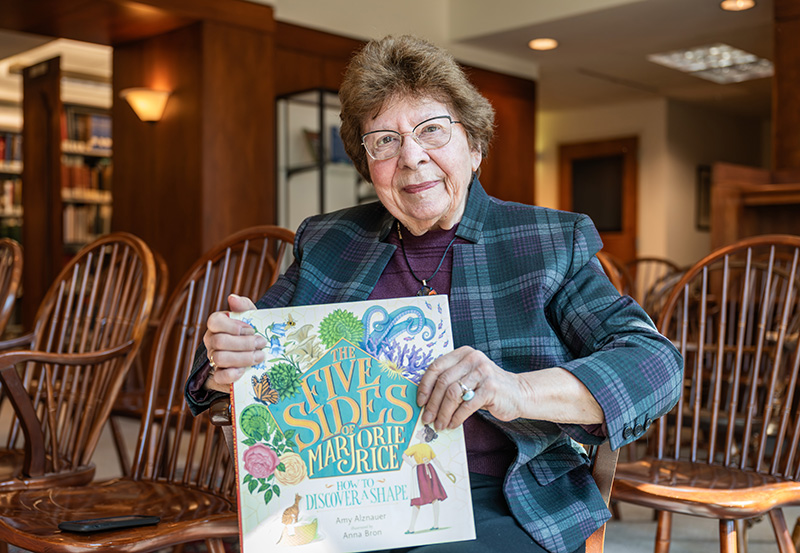
Professor Emerita Doris Schattschneider with Amy Alznauer’s book, The Five Sides of Marjorie Rice: How to Discover a Shape. Photo by Nick Chismar ’20
Professor Emerita Doris Schattschneider knows that math has a way of bringing people together. Early on in Schattschneider’s 34-year teaching career at Moravian University, a chance correspondence over a geometric puzzle brought a math discovery to light and blossomed into a lifelong friendship.
That camaraderie between Schattschneider and amateur researcher Marjorie Rice is now celebrated in Amy Alznauer’s 2025 children’s picture book, The Five Sides of Marjorie Rice: How to Discover a Shape. In February, the book received a national Mathical Book Prize, an annual award for fiction and nonfiction books that inspire children to see math in the world around them.
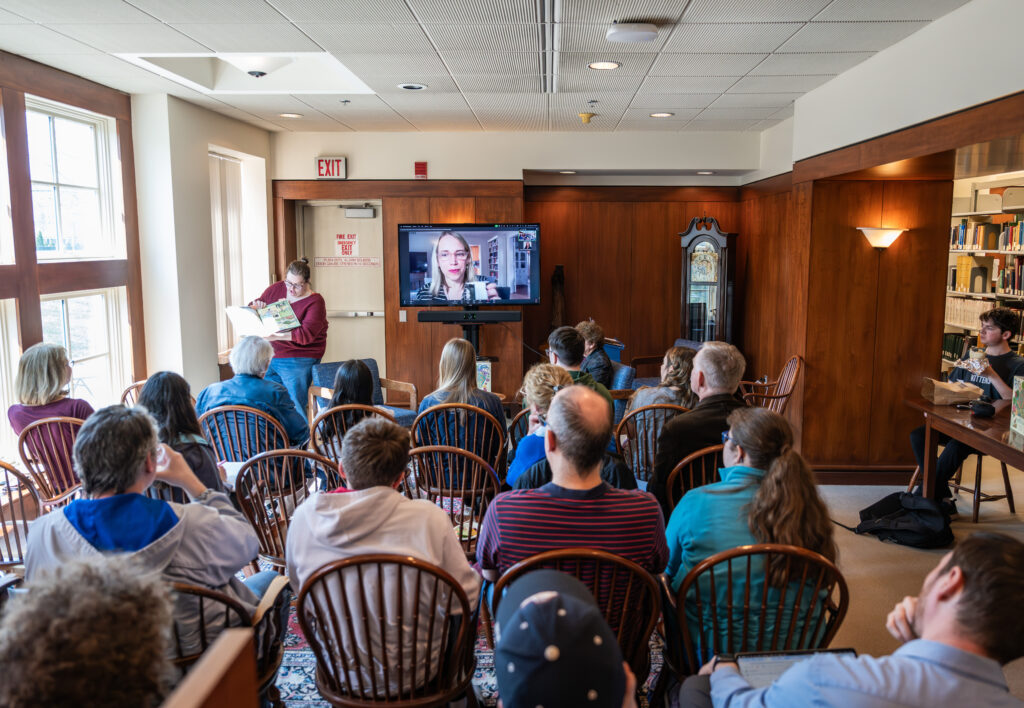
Moravian faculty and students as well as members of the community gathered at Reeves Library on March 26 to hear Alznauer and Schattschneider talk about the writing process and history behind the book.
It tells the story of Rice from her early childhood to her years rearing her own children, all the while pursuing her passion for mathematical discovery. Colorful illustrations by Anna Bron depict the intersection of art and math in Rice’s life.
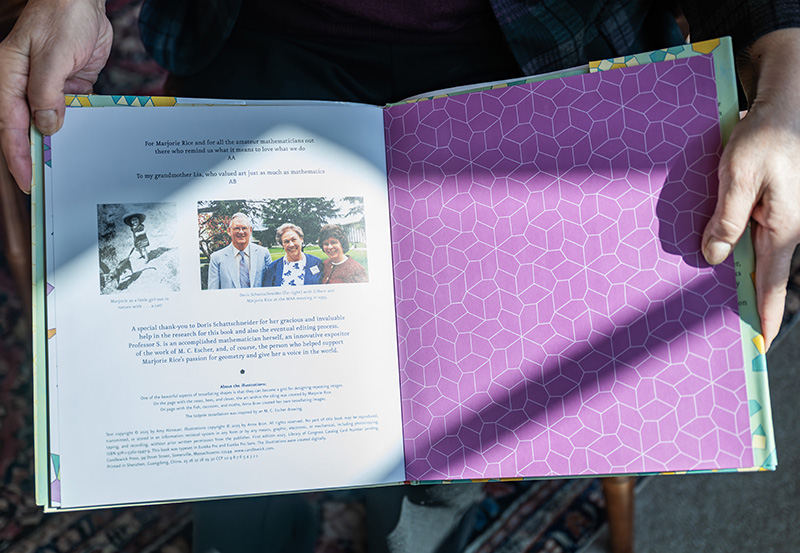
Schattschneider, referred to as Professor S. in the book, plays a prominent role in corroborating Rice’s work, supporting her with math resources, and sharing with her a genuine delight in geometry. Rice passed away in 2017 at the age of 94.
Alznauer, who, in addition to writing, teaches math at Northwestern University, talked about bringing the story to life and introducing readers to someone who is relatively unknown outside of mathematical circles. “Here is the quintessential story of an amateur,” she said of Rice. “Here she is at home getting no money for this, no status . . . she’s just doing it because she loves it and it’s a joy for her.”
Alznauer, who joined the Reeves presentation via Zoom, worked closely with Schattschneider while writing the book. In addition to providing the details of her correspondence with Rice, Schattschneider weighed in on the mathematical details, making sure the illustrations and text properly represent the underlying concepts.
At the event, Moravian librarian Kris Beutler read an excerpt from the book to those in attendance, many of whom represented Moravian’s education and math departments. “We are the intersection of all departments, so we love bringing things like this together,” she said.
Looking For a Shape
Rice’s story shows the value of persistence. As a full-time wife, mother, and homemaker living in California, she had no formal mathematical training beyond a general high school course. Nonetheless, her inquisitive mind helped her see geometry in the world all around her.
“Here is the quintessential story of an amateur. Here she is at home getting no money for this, no status . . . she’s just doing it because she loves it and it’s a joy for her.”
Author Amy Alznauer
In 1975, Rice read a column in Scientific American by mathematics writer Martin Gardner. He wrote about tiling, the geometric concept of identical shapes, or tiles, fitting together perfectly so as to cover a surface without any gaps. While it had been thought that only eight different types of convex pentagons could tile a surface, the column announced the discovery of a new five-sided tiling shape.
Inspired to start searching for yet another pentagon that would tile, Rice worked on her own until she found one. She shared her findings with Gardner, who became her connection to Schattschneider.
An Authority on Tiling
Far from a novice, Schattschneider was a mathematics professional. She received a doctorate from Yale and had been teaching math for nearly eight years at Moravian when she first corresponded with Rice. In fact, Schattschneider had developed her own course about symmetry and tiling that made her just the right expert to advise Rice.
Earlier in her career at Moravian, Schattschneider had been presented with the opportunity to create a course from scratch for the special January term. “The only requirement was that we could not teach anything that was in the course catalog,” she said.
Schattschneider set out to make a course on mathematics as it relates to art and design. “It was really a study of symmetry, of classifications, of how you create repeating designs . . . what mathematics underlies it,” she said. While there wasn’t an existing textbook for this kind of undergraduate class, she put together her own notes and found books to show visual examples.
One of the books she used featured the tessellations of graphic artist M.C. Escher, famous for his optical illusions and artwork based on mathematical concepts. “That got me really interested in Escher’s work, but it also got me really interested in both the analysis and creation of tessellations, which mathematicians call tilings,” she said.
As Schattschneider continued to teach the January term course, her own understanding and expertise deepened. An expert in the field, she had already corresponded with Gardner, the columnist, helping verify the same pentagon discovery that had inspired Rice to begin her search. So, when Rice sent Gardner her findings in 1976, he passed the work on to Schattschneider “for vetting, to make sure this really was a new discovery,” she said.
Decades-Long Correspondence
Schattschneider verified that Rice’s work was indeed a new discovery, and the two began corresponding. Their handwritten letters held an ongoing discussion of tiling pentagons. Schattschneider sent Rice articles and visuals she thought would be helpful. Every few months, she received Rice’s sketches of pentagonal tilings in return.
Schattschneider validated several more discoveries by Rice through the years. She also served as a de facto spokesperson, presenting these findings at conferences and in journals. Always, she gave due credit to Rice.
While math was a primary focus, Schattschneider also learned about Rice’s life.
“In a couple of the letters she basically told me her life story,” said Schattschneider, who incorporated Rice’s biographical details into her 1981 article “In Praise of Amateurs.” That article, in addition to detailed proofs and diagrams of Rice’s work up to that point, recounts her early years, her first exposure to tiling, and her persistence in its pursuit. Schattschneider’s correspondence with Rice went on for nearly 30 years, until Rice’s death.
Today, both women’s letters and Rice’s research notes are kept in the Eugene Strens Recreational Mathematics Collection at the University of Calgary Library in Alberta. The collection also includes Rice’s original tessellation drawings, illustrated with colorful interlocking patterns of flowers, bees, butterflies, and fish. “It’s the best place it should be,” said Schattschneider. “It’s the only collection that I know of that is dedicated to the work of so-called amateur or recreational mathematicians.”
Making Math for Everyone
At Moravian, Schattschneider showed that math is more than numbers on a page. “You can study tiling without any formulas or numbers. It’s not exclusionary the way that some of the fields of mathematics can be,” she said.
That legacy continues beyond her retirement from the math department in 2002. Her course on art and math was offered for nearly two decades following her departure.
“When she retired, it was passed on, and I was the last to teach it,” said Associate Professor of Practice in Mathematics Trisha Moller, who was in the audience at the library event on March 26. Moller said she enjoyed showing students how math intersects with visual perspectives, architecture, and shapes. She hopes the class can be offered again one day.
Moller described how students can learn to approach math in creative and beautiful new ways, citing one student who created a three-dimensional crochet piece in her class. “She was depicting a wavy surface, and the best way to do that was crochet,” Moller said. “Math is a language, and we can communicate that language in many forms.”
Alznauer agrees that math and art go hand in hand. “You’ll hear mathematicians talk about mathematical beauty, and that’s really hard for some people to understand,” she said. “What they’re really talking about is an intuitive sense of elegance, of pattern, of simplicity.” —Lindsey Poncavage
The Five Sides of Marjorie Rice: How to Discover a Shape is available at the Moravian Book Shop at 428 Main Street in Bethlehem. The book can also be specially ordered if it’s no longer in stock.