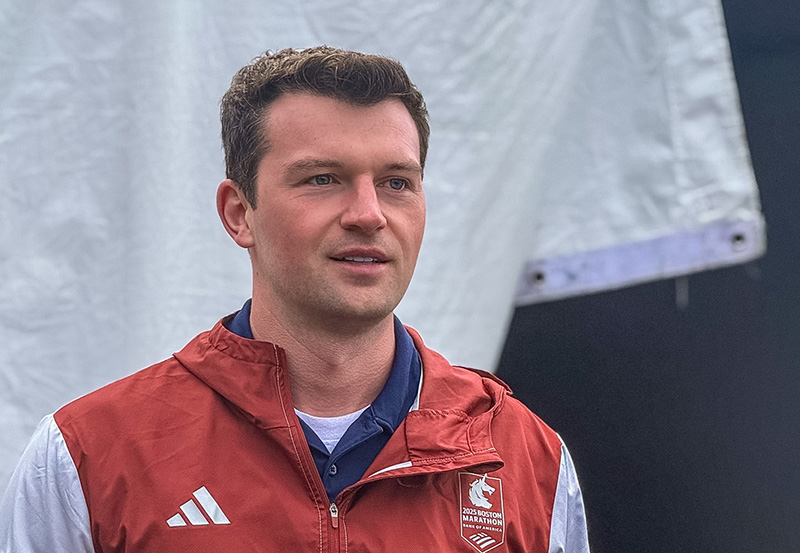
Ty Bigelow G’22, G’24 is one of 10,000 volunteers at this year's Boston Marathon. Submitted photo
Ty Bigelow G’22, G’24 shares his experience as a volunteer with the world’s best-known marathon.
On April 20, more than 30,000 athletes are expected to descend on Boston for the 130th annual Boston Marathon, each striving to conquer the oldest annually held marathon in the world.
On the sidelines, specially trained volunteers like Ty Bigelow G’22, G’24 ensure that athletes make it safely across the finish line. Bigelow, who earned his doctor of athletic training degree in 2022 and his MBA in 2024, both from Moravian University, is among 10,000 volunteers supporting this year’s Boston Marathon, according to the Boston Athletic Association (BAA).
Bigelow works as an associate athletic trainer at Villanova University and has been volunteering as a course athletic trainer with the Boston Marathon since 2024. In his role at Villanova, he is responsible for the women’s soccer, track and field, and cross country teams. He is also chair of the Eastern Athletic Trainers’ Association (EATA) Scholarship Committee.
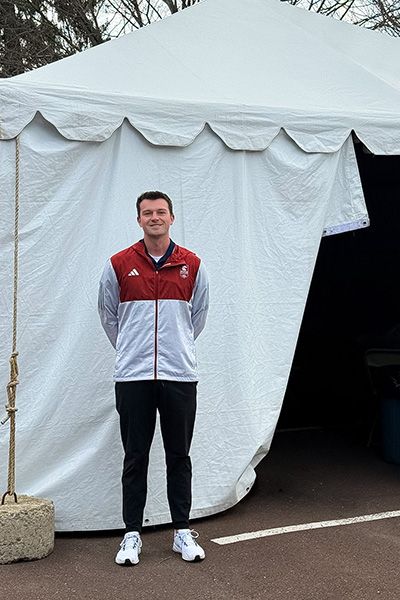
At an event like the Boston Marathon, Bigelow says he works with a broad range of athletes, including elite runners and older adults. He also works with fellow volunteers he may not know. “It really boils down to good communication, building those professional relationships the morning of the race, when you finally meet everyone who’s part of your team,” he says.
While it’s challenging, Bigelow looks forward to “Marathon Monday” every year. “From the moment the marathon ends, prep begins for the next year,” he says. “It takes a lot of people to keep the marathon running, but I feel like my job is easiest because I can show up on race day, do what I love to do, and then go home.”
This year he’ll be stationed at mile 19, between Homer Street and Commonwealth Avenue in Newton. The area is known for Heartbreak Hill, a famous incline in the last leg of the marathon, thought to be the most challenging segment because it’s the final hill and is more than halfway through the race.
According to the BAA, Bigelow’s medical station is one of 26 along the full route. Each tent is staffed with healthcare professionals from various disciplines, including athletic trainers, physicians, paramedics, EMTs, nurse practitioners, nurses, and physician assistants.
“Athletic trainers have long been a key part of the Boston Marathon due to the skill set we have in field medicine, musculoskeletal injuries, and event management,” Bigelow says. He estimates that about 100 patients stop by the medical tent on the day of the race. Bigelow has assisted runners with such ailments as ankle sprains, tendinitis, and chest pain. Last year, two runners suffered heatstroke but fortunately had good outcomes, he says.
On race day, volunteers meet on the course as early as 5:30 a.m. to begin unloading equipment. Medical volunteers run through different scenarios to make sure their setup works smoothly for issues from minor scrapes to serious conditions like cardiac arrest, Bigelow says.
“Emergency action planning is a key part of athletic training, so this is a big task I like to focus on,” he says, “because when the race begins, there is no time to make significant changes to the [medical tent] space or spend minutes finding where specific equipment is.”
Bigelow credits the emergency care courses he took with Ellen K. Payne, Moravian University associate professor of athletic training, with preparing him for his volunteer hours with the marathon.
Payne says Bigelow was a great student and is now an even better athletic trainer and young professional. As chair of the EATA scholarship committee, Bigelow is “helping the next generation of athletic trainers be rewarded for their hard work and academic excellence,” Payne says.
Volunteers like Bigelow are “the heart and soul of the Boston Marathon,” says Alaina Lotsbom, the BAA’s director of volunteer and community programs. “We couldn’t produce an event of this scale without the dedication, passion, and enthusiasm of our volunteers.”
As for whether he will ever run in the Boston Marathon, Bigelow says he’s happy to stay on the sidelines, adding that it’s important to know your skill set. “They are skilled at running. Me? Not so much,” he says. “I think I’ll stick to my skills in delivering healthcare.” —Christina Tatu
Boston Marathon Facts
The 130th Boston Marathon Presented by Bank of America will be held on April 20.
- More than 30,000 entrants from nearly 130 countries and all 50 states are expected to participate.
- More than 500,000 spectators line the course annually through the eight cities and towns leading to the finish line.
- The first Boston Marathon took place April 19, 1897, organized by Boston Athletic Association member and inaugural US Olympic Team Manager John Graham. He was inspired to develop the Boston race after witnessing the spirit of the Olympic Marathon.
- For the first Boston Marathon, a distance of 24.5 miles from Metcalf’s Mill in Ashland to the Irvington Oval in Boston was selected. John McDermott was the winner, with a time of 2:55:10.
- In 1924, the race was lengthened to 26 miles and 385 yards to conform to the Olympic standards, and the starting line was moved west from Ashland to Hopkinton.
- Roberta Gibb was the first woman to run the Boston Marathon. She famously jumped out of the bushes in Hopkinton in 1966 and completed the course in 3:21:40. A year later, Kathrine Switzer became the first woman to complete the race with a bib number.
- The Boston Marathon became the first major marathon to include a wheelchair division competition when Bob Hall was recognized in 1975. He raced with a time of 2:58.
- In 2022, Kenya’s Peres Jepchirchir became the fourth woman and fifth athlete to win both the Boston and Olympic Marathons. She went on to become the first athlete in history to win Olympic, Boston, and New York City Marathon titles across her career.
Information courtesy of baa.org/races/boston-marathon/history/.