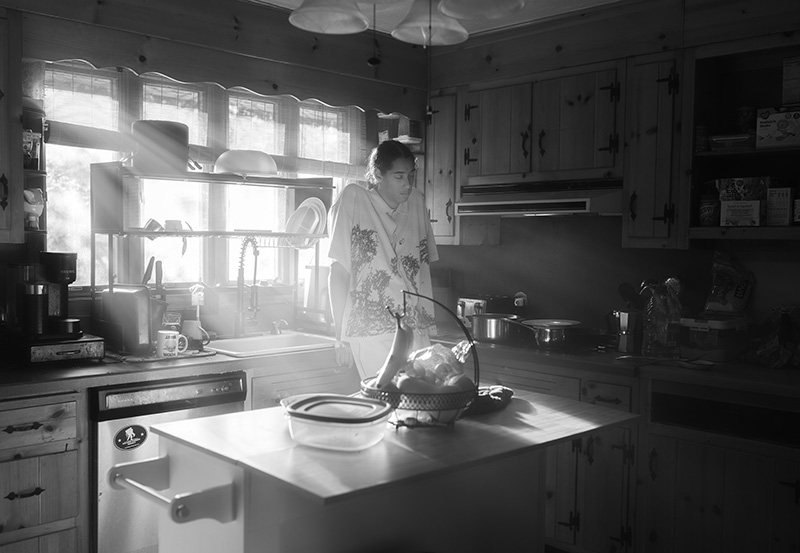
Titled, "Pat in the Kitchen," this photo by Javier Griffey ’23 shows his brother in the family's smoke-filled kitchen.
Artist Javier Griffey ’23 explores new means of photographic expression as he interrogates relationships, identity, and place.
Some photographers specialize in landscapes; others, portraits; and still others, street scenes. Javier Griffey photographs questions.
The recipient of the Fellowship 26 Keystone Award presented by Silver Eye Center for Photography in Pittsburgh, Griffey graduated from Moravian in 2023 and earned an MFA from the Columbia University School of the Arts in 2025.
The Keystone Award is given to an exceptional photographer living or making work in the Commonwealth of Pennsylvania. Griffey credits Angela Fraleigh, professor of art at Moravian, and Susan Morelock, former professor of photography at Moravian, with nurturing his early development as an artist.
“Susan helped me become invested in photography and examining photographers who question the medium in interesting ways. Angie encouraged me to be creatively curious and urged that if you have an inkling to pursue something photographically, do so with an open mind but at the same time critically to achieve what you’re after.”
Fraleigh extols Griffey and his work. “Javier is truly an exceptional photographer and one of the most outstanding young artists I have had the privilege to teach. [His] work is spellbinding. His photographs are haunting and hallucinatory. He draws from his own difficult beginnings and personal narrative, but his works transcend the particular and can be read as universal.
“He creates an emotional landscape of light, each [photograph] seeming to outline individual chapters of an ongoing psychological narrative. He creates raw, tender dreamscapes that explore the many intricacies of human relationships with the self and with others.”
For Griffey, photography is about asking questions through visual means. “Often I have internal things that I want to figure out. My strongest work is embedded with raw emotion about a concept that I am struggling to express to myself.”
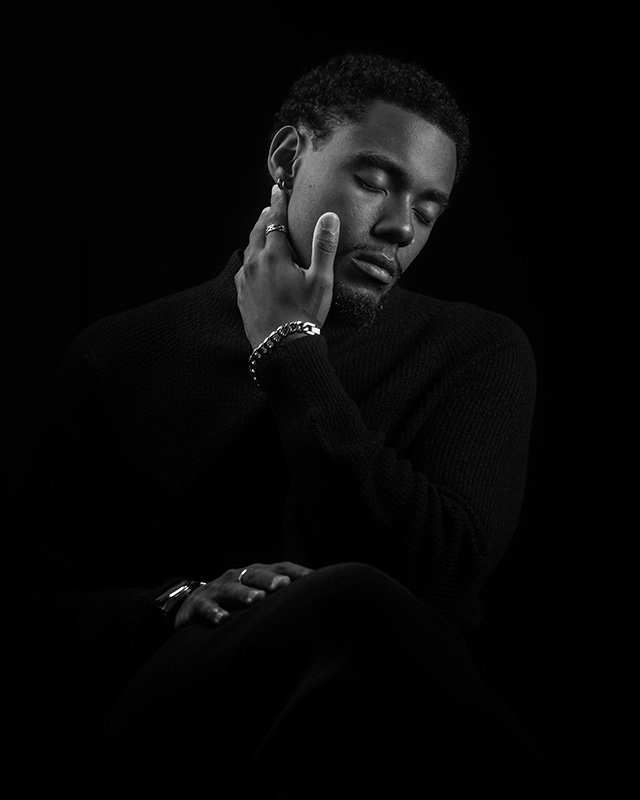
Griffey finds that emotion and ideas are more powerfully expressed in black and white than in color. In several of his images, the viewer can see the influence of American photographer Roy DeCarava (1919–2009) and his images of jazz musicians whose brightly lit gestures and movements emerge from a seemingly infinite black space. “There is an emotional content, because all you can focus on are the gestures and the light,” Griffey says.
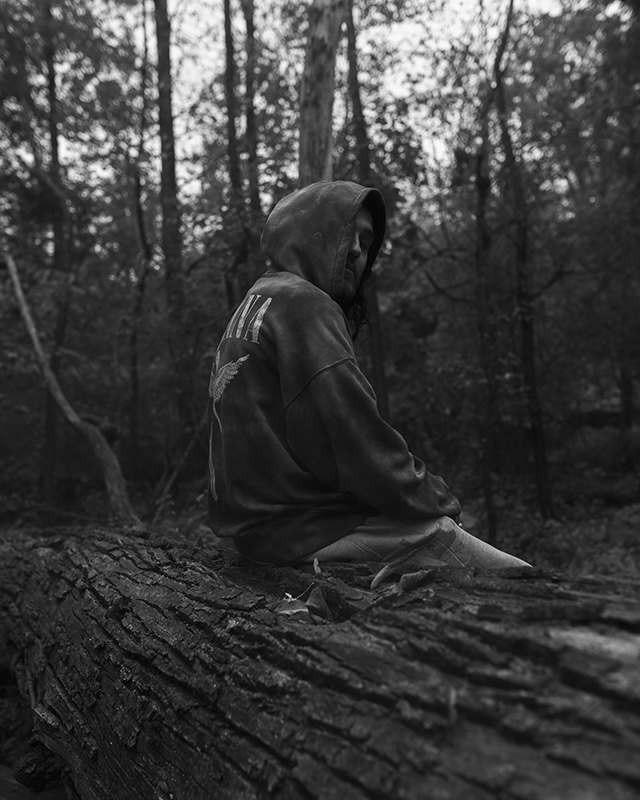
Early on in his work, Griffey would create single images. “But my experience in grad school welcomed the generosity that the series offers. I now mostly work with a series around a certain theme that develops into a narrative.”
His master’s thesis, I Have No More Tears Left to Cry, portrays a narrative of his mother and his memories of her. The series So Mote It Be follows the end of a romantic and creative partnership.
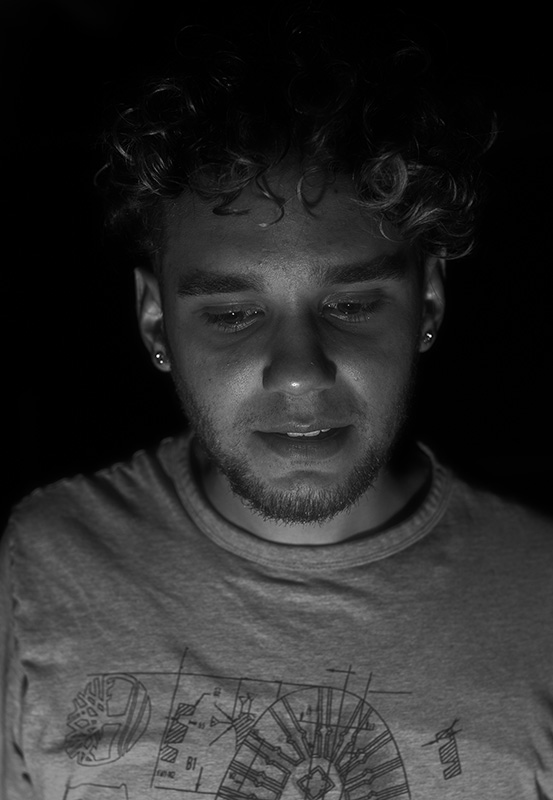
Griffey explains that when he photographs a person, the conversation that occurs before he pulls out his camera and everything else that goes into creating the photo before and after the image is made are unknown to the viewer.
“Moments like that are really exciting for me,” Griffey says. They ignite his creativity in exploring different ways of communicating what lies in those spaces and what he cannot photograph, including bringing archival material into his work.
In the series I Have No More Tears Left to Cry, a photo shows a plaque leaning against a Home Depot box. The plaque displays a group portrait of Griffey as a child with a brother, a cousin, and Griffey’s mother. The family moved frequently, and Griffey recalls that his mother would take the plaque wherever they went.
Griffey continued to explore new ways to build on the narrative of his work in the fellowship he created for an exhibition at Silver Eye Center for Photography, which opened on May 21 and closes on August 8, 2026. In one segment of the installation, he placed a photograph of a sky with text and an image of his mother as a child. Each piece was created separately and at a different time; in unison they convey an emotion, Griffey explains.
“I’ve stopped trusting the photograph to convey what I need to say. Instead, I’m layering photographs with handwritten text and family archives, treating the image as just one voice in a larger conversation about what gets lost between generations, languages, and forms.”
This work, In Between You and I, grapples with Griffey’s inner questions concerning identity and belonging.
Griffey’s parents met in the army at ages 20 and 21. They never married. Griffey’s mother is a first-generation Dominican American who grew up in New York City. His father lives in Atlanta. When Griffey’s father is asked about his heritage, he replies, “I am a Black American.”
“Over the years, I would float between these spaces, never claiming one or the other,” Griffey says. “I often feel lost without anything to hold on to.
“In Between You and I addresses my relationships with both my parents and what happens to me in the space between them.
“I write to my mother, asking her who she was before I existed. I write to my father, grieving the presence I’ve never had with him. And in writing to them, I’m writing to myself, because in trying to reach them both, I’ve lost myself. The text and images layer together to show that loss, that displacement. The work is about belonging nowhere and everywhere at once.” —Claire Kowalchik P’22