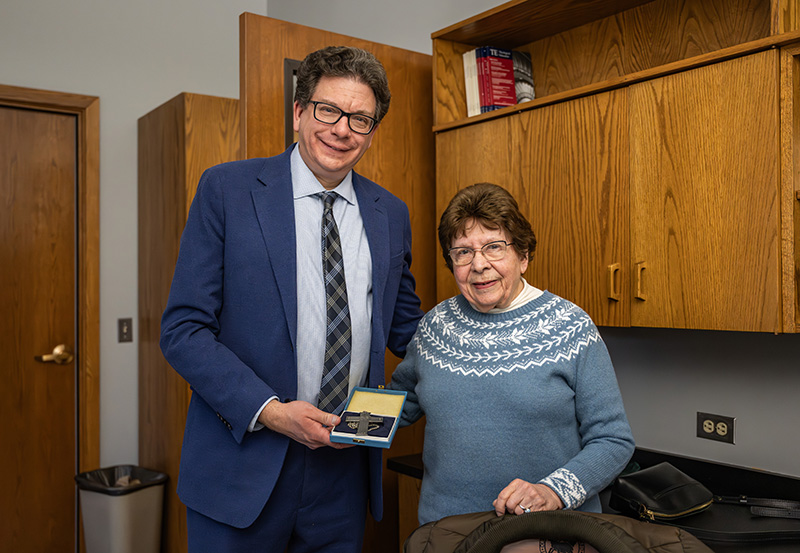
Christian Rice, dean of the Moravian University School of Theology and Doris Schattschneider pose with a pewter cross medallion her husband, and former dean, David Schattschneider left for his successor. Photo by Nick Chismar ’20
A 25-year-old letter offers words of wisdom, and a pewter cross medallion is a symbol of Moravian University School of Theology traditions passed down through the generations.
Christian Rice was between meetings on a busy afternoon last fall when he sat down for a much-needed break in his office at Moravian University’s Bahnson Center. Still in the early months of his new role as vice president and dean of Moravian University’s School of Theology, Rice had a full calendar and had not yet finished unpacking in his new office.
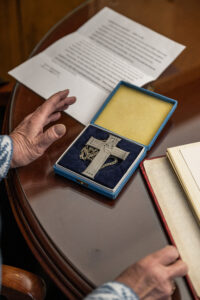
As he opened the drawers of a built-in wall unit, Rice discovered a slim blue box tucked beneath a yellowing envelope bearing a typewritten note: “Greetings from the Former Dean.” Though the message was written 24 years earlier, both the note and the pewter cross medallion enclosed with it still resonated deeply with the responsibilities of Rice’s new role.
Dated October 22, 2001, the note was from David Schattschneider ’60, a longtime professor and dean of the Moravian School of Theology, who worked at the university from 1968 until his retirement in June 2001. Schattschneider had addressed the note to whoever his successor might be.
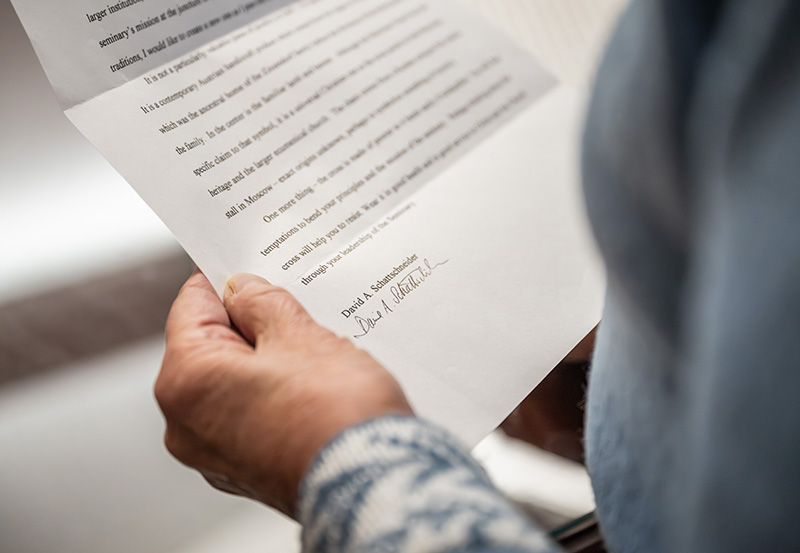
“For 13 years I have worn this cross on formal academic dress occasions. It is an external reminder of the unique history and role of the seminary within the larger institution, and of the office of the Dean,” Schattschneider wrote.
The pewter cross isn’t an expensive piece of jewelry, but its value is in what it symbolizes, which for Schattschneider included the seminary’s mission “at the juncture of faith and knowledge.
“Now after having taught about Moravian traditions, I would like to create a new one as I pass this cross on to you,” he wrote. Schattschneider ended his letter by noting that the cross is made of pewter, so it bends easily if mishandled.
“You will face temptations to bend your principles and the mission of the seminary. Perhaps thinking about the cross will help you to resist. Wear it in good health and in good service to Christ and the Church through your leadership of the Seminary.”
A New Dean, a New Seminary
Rice, who grew up in the Moravian Church and worked in theological education at Ursinus College for 18 years before joining Moravian, instantly recognized Schattschneider’s name. The former dean was a well-traveled man who became “somewhat of an icon” at Moravian’s seminary, Rice says.
During the annual seminary senior banquet, Schattschneider was known to dress up as Count Nicholas Ludwig von Zinzendorf, founder of the reformed Moravian Church. With a thick German accent, he and a colleague would “roast” their fellow faculty members and some students. Those who worked with Schattschneider remember him for his quick wit, mastery of historical facts, and sophisticated understanding of the intersection of history and theology.
“It felt really special to me,” Rice says of the letter. “He was a really important person for the seminary, and in the letter he’s speaking about change and moving forward, but also making sure you are true to your principles.”
Rice’s discovery of the letter and cross happened during an important juncture in the theological school’s history—just two months after Moravian University finalized the merger between Moravian Theological Seminary and Lancaster Theological Seminary, forming the new Moravian University School of Theology. The strategic move united the faculty, staff, and resources of the two seminaries. It consolidated operations while preserving each institution’s identity and generating expanded academic offerings through a new curriculum taught by a combined faculty with more areas of expertise, Rice says.
“We have this brand-new school of theology that is a combination of two historic seminaries. We need guidance moving forward, but we also have to be aggressive and adaptive, while at the same time not losing sight of our true north, which is serving students and being true to our heritage,” Rice says.
A Family Legacy
Across more than a century, the Schattschneider family has remained closely intertwined with Moravian University and its ministry. The Rev. William C. Schattschneider was the first in the family to attend what was then Moravian College. He graduated in 1898 and went on to graduate from Moravian Theological Seminary in 1900.
William’s sons, Allen and Douglas, also came to Moravian College and Theological Seminary to become ministers. Allen, who was David’s father, graduated from Moravian in 1923 and Moravian Theological Seminary in 1925. He served Moravian congregations in New York, Pennsylvania, and New Jersey and was elected bishop in 1961. Douglas graduated from Moravian in 1926 and the seminary in 1928. He went on to serve more than 30 years at the Moravian church and school in Bethel, Alaska.
Allen served on the Board of Trustees of Moravian from 1956 to 1968. He was awarded an honorary doctor of divinity degree by the seminary in 1958 and received the 1997 John Hus Alumni Award.
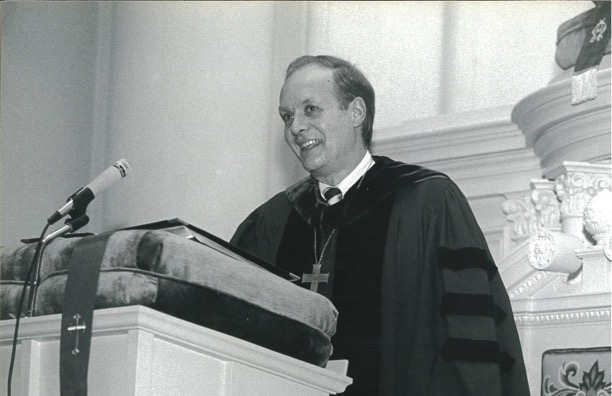
David followed in his family’s footsteps, graduating from Moravian in 1960. He earned his master of divinity degree from Yale Divinity School and a doctorate from the University of Chicago. His tenure at Moravian Theological Seminary began in 1968 as a professor of historical theology and world Christianity. He was appointed dean in 1988 and served in that capacity until his retirement in 2001.
In 2016, the seminary awarded David an honorary doctor of divinity degree in recognition of his global contributions in the field of Moravian history and his leadership at the university. David died that same year, but his wife, Professor Emerita of Mathematics Doris Schattschneider, continues to be active in the community and on campus. She was recently the subject of a national award–winning children’s book.
The Cross from Vienna
Doris, now 86, remembers spotting the heavy, matte silver cross in an antiques shop during one of the couple’s many trips abroad. The Schattschneiders visited Vienna often to keep in touch with family friends, and Doris believes the cross was purchased during one of these visits in the mid-1980s.
“I convinced David to buy it, and he wore it anytime he had on his full academic regalia,” Doris said during a visit to Rice’s office this past spring. It was the first time in decades that Doris had seen the cross. She shared photo albums from David’s years at Moravian as she looked over the cross and letter with Rice.
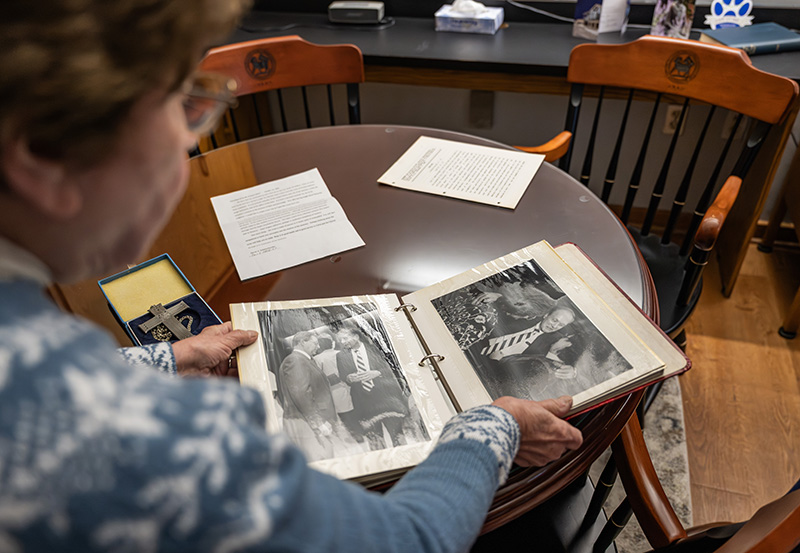
In one of the albums, David is pictured wearing the cross during his installation as dean of the Moravian Theological Seminary on November 17, 1988. The cross is embossed with the familiar symbol of a lamb holding a flag with a cross, or Agnus Dei, which is Latin for Lamb of God.
David wrote in his letter that the cross is a “contemporary Austrian handicraft product” from the region of southern Austria—the ancestral home of the Zinzendorf family. The lamb “is a universal Christian [symbol], so the cross points to both Moravian heritage and the larger ecumenical church,” he wrote. The thick silver-link chain comes from a “Russian antiques flea market stall in Moscow—exact origins unknown, perhaps to symbolize something of mystery.”
A Symbol for Fellow Leaders
Since David retired, there have been four deans to oversee the seminary—now five including Rice. Dean and Professor of New Testament Emeritus Rev. Dr. Frank Crouch S’80 recalls finding David’s letter and says he felt fortunate to have known David as a professor, mentor, and colleague.
Crouch worked at Moravian Theological Seminary for 25 years before his retirement in 2021. He was appointed dean in 2001. Crouch was a student in the seminary when he first met David. What Crouch remembers most is David’s spirit.
“For a long time, I’ve said that at our best, Moravians are guided by the ideal of ‘in essentials, unity; in non-essentials, freedom; in all things, love,’” Crouch wrote in an email. “But David exemplified that ideal as dean, as professor, and as just another human being as well as anyone I’ve known.”
Crouch wore the pewter cross during opening convocations and commencement ceremonies. The letter and medallion reflect who David was, “a smart, observant man who cared equally for students, staff, faculty, and the seminary as a whole,” Crouch wrote.
“He led with a calm, ethical, faithful grounding and an open, welcoming spirit combined with his ability both to take important things seriously and to foster community in the classrooms, meetings, and hallways with grace and a sense of humor.” —Christina Tatu