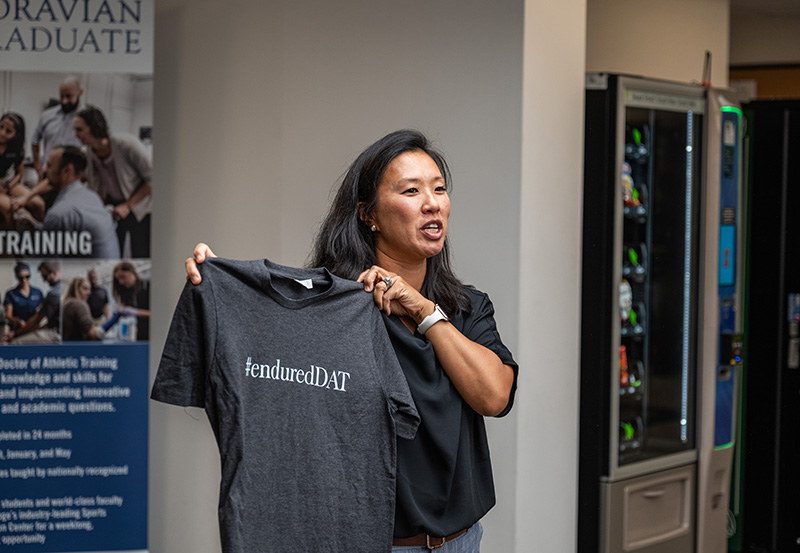
Kristin Funk Maguire at Moravian University's DAT Summer Institute in 2024. Photo by Nick Chismar ’20
Hear from the graduates who earned Moravian’s Doctor of Athletic Training (DAT) degree and learn about how the program advanced their careers.
Kristin Funk Maguire G’21
Funk Maguire is head athletic trainer at Commonwealth University of Pennsylvania’s Bloomsburg campus.
Q: What aspects of Moravian’s mission or curriculum truly resonated with you?
A: The DAT program helped me establish a strong leadership foundation as I transitioned back into full-time collegiate athletic training after taking time away to raise my two young children. What initially drew me to the program was the clinical programming—especially in the areas of manual therapy and the evidence supporting this type of care. It allowed me to become a well-versed manual therapist, capable of treating the body as a whole, which has led to better patient outcomes. The leadership aspect of the program was a hidden gem that helped uncover and refine my authentic leadership skills while enhancing my communication, charisma, and overall professional disposition. These skills have been invaluable in collaborating not only with fellow AT staff, but also with the athletic department, coaches, and the university community as a whole. Additionally, the program provided opportunities to expand my professional network, opening doors for me to give back to the profession—most notably through my current role contributing at local level, on the Executive Board of the Pennsylvania Athletic Trainers’ Society.
Q: How has the DAT program transformed the way you approach patient care or organizational leadership?
A: Through Moravian’s DAT program, I gained a stronger foundation in evidence-based clinical decision-making, which I now apply regularly in assessment, treatment planning, and outcome tracking. I also developed structured frameworks for organizational leadership and professional advocacy, giving me the confidence to lead interdisciplinary teams, advocate for resources, and implement practices that enhance both patient outcomes and staff efficiency. The combination of clinical refinement and leadership development through the DAT truly shaped the course of my career, opening doors I had never envisioned.
Q: Why did you decide to go into athletic training and how have your reasons evolved? What do you enjoy about your role?
A: I am currently the head athletic trainer at a Division II university—a trajectory I never imagined for my career. After finishing college, I always thought I would return to my small high school to care for their athletic teams. The DAT program, however, transformed both my approach to patient care and my leadership in ways that allowed me to grow into this role.The most rewarding part of my job is combining critical thinking with hands-on manual therapy to create meaningful change for patients recovering from musculoskeletal injuries. I love learning new manual therapy techniques and applying them directly to improve outcomes for my athletes. Equally rewarding is the opportunity to share this knowledge with my fellow staff and the master’s athletic training students who do immersive experiences with us, helping to cultivate the next generation of clinicians.