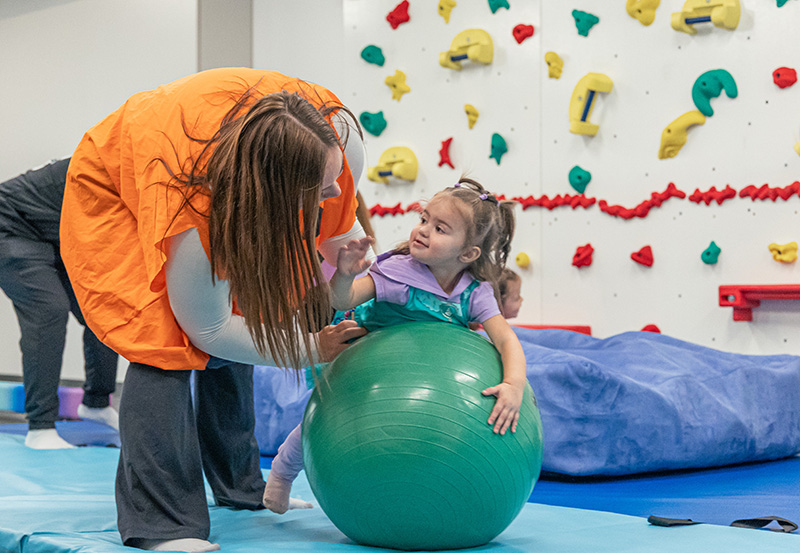
Moravian University hosted its annual Pediatric Occupational Therapy Pro Bono Clinic this fall. This year, the clinic assisted 14 children. Photos by Rey Gabriel '28
For the fourth year, Moravian hosted its Pediatric Occupational Therapy Pro Bono Clinic, providing occupational therapy services to local children at no cost to families.
Each year the program gets “bigger and better,” said Glynnis Jones, an assistant professor in Moravian’s occupational therapy program. The clinic provides services delivered by second-year occupational therapy graduate students under the supervision of licensed occupational therapists. This year, the clinic hosted 14 children from ages 8 months to 9 years. The program ran from October 7 to November 13 at Moravian’s Sports Medicine and Rehabilitation Center (SMRC) on Schoenersville Road.
“The students learn to apply classroom knowledge to the individual needs of a child, hone their clinical reasoning and intervention skills, and practice family-centered care,” says Jones. “Beyond clinical skills, students develop professional confidence, empathy, and communication abilities, preparing them to become thoughtful and competent occupational therapists.”
Additionally, the clinic can be life-changing for the children and families who participate, she says. Many of the families face long wait lists, lack of insurance, or limited access to care.
“Through the clinic, they receive quality occupational therapy services at no cost, along with guidance and strategies to support their child’s development at home. For some families, this clinic represents the first opportunity their child has to engage in occupational therapy, making a profound impact on daily life, learning, and independence,” Jones says.
Below Jones answers some questions about the clinic:
Q: What is occupational therapy and how does it help?
A: Occupational therapy (OT) helps children develop the foundational skills needed for daily activities or “occupations,” such as playing, learning, dressing, eating, and interacting with others. When a child faces challenges that affect these skills, OT focuses on strengthening underlying abilities like coordination, attention, sensory processing, and self-regulation.
This year, we worked with children who have a variety of diagnoses, including autism spectrum disorder, attention deficit hyperactivity disorder, cerebral palsy, and developmental delay. We also see children with rarer medical conditions, such as Joubert syndrome. Importantly, children who attend the clinic do not necessarily need a formal diagnosis—they may simply have a specific need, such as difficulty with fine motor skills, sensory processing, self-regulation, or participation in daily activities.
Q: How has the clinic grown over the past four years?
A: The Pediatric OT Pro Bono Clinic began in fall 2022, during my first semester at Moravian, as a small, four-week experiential learning opportunity with just five families participating as part of a four-credit course. Inspired to expand and improve the experience, I developed and launched the official Pediatric Pro Bono Clinic in fall 2023 within the course OT643: Occupational Performance III: Contextual Applications. That year, we worked with 13 families and collaborated with community stakeholders to provide a more structured, meaningful experience for both students and children.
In fall 2024, the clinic continued to grow, welcoming returning families. We expanded the program to six weeks and added a Halloween event, where students created themed activities, children and students dressed in costumes, and families enjoyed trick-or-treating throughout faculty and staff offices in the SMRC.
In 2025, the clinic continues to thrive with 14 families participating in the six-week program, along with the annual Halloween celebration. Over the past four years, the clinic has grown from a small course-based experience to a fully established community-focused program, providing valuable experiential learning for students while offering free occupational therapy services to children and families in need.
Q: How many students participated in this year’s clinic, and are there any local occupational therapists who volunteer their time?
A: This year’s clinic included 29 second-year students from the MSOT program. In addition, 18 licensed occupational therapists from the community generously volunteered their time to supervise sessions and mentor students. These clinicians represent a range of settings, including Good Shepherd, Lehigh Valley Health Network, Bethlehem Pediatric Therapy Services, and Fox Rehab. The clinicians offer students constructive feedback to help refine their clinical reasoning, therapeutic use of self, and professional skills.
Q: What kind of jobs will these students be eligible for upon graduation?
A: Our students must sit for the National Board for Certification in Occupational Therapy exam and obtain state licensure before practicing. Once licensed, they become official occupational therapists and have a wide range of career opportunities across multiple settings. Many begin their careers in hospitals, rehabilitation centers, or outpatient clinics, supporting patients recovering from injuries, surgeries, or illnesses. Others pursue positions in pediatric or school-based settings, working with children who have developmental, sensory, or physical challenges. Additional opportunities include long-term care facilities, home health, mental health settings, and community-based programs. Occupational therapists may also choose to specialize in areas such as hand therapy, treating injuries of the hand, arm and shoulder; assistive technology, and neurological rehabilitation. Overall, graduates leave the program prepared for diverse roles, equipped to apply clinical reasoning, therapeutic skills, and client-centered care to help individuals across the lifespan achieve independence and improve their quality of life.
The next six-week Pediatric OT Pro Bono Clinic will be offered in fall 2026. For additional information, please contact Glynnis Jones at jonesg02@moravian.edu. To learn more about Moravian’s occupational therapy program visit https://www.moravian.edu/rehab/occupational-therapy.